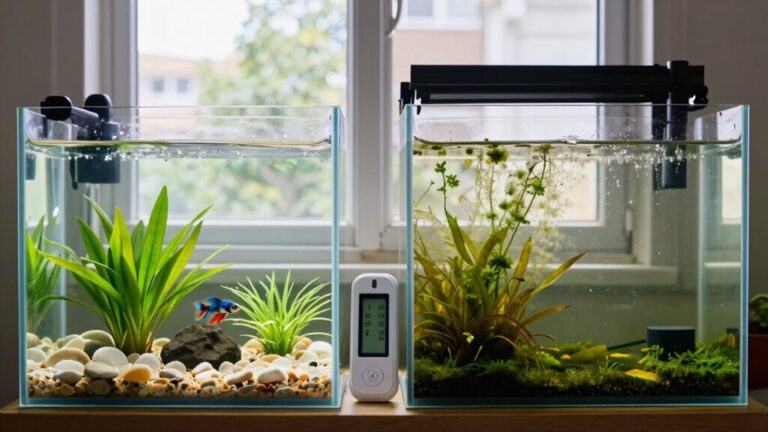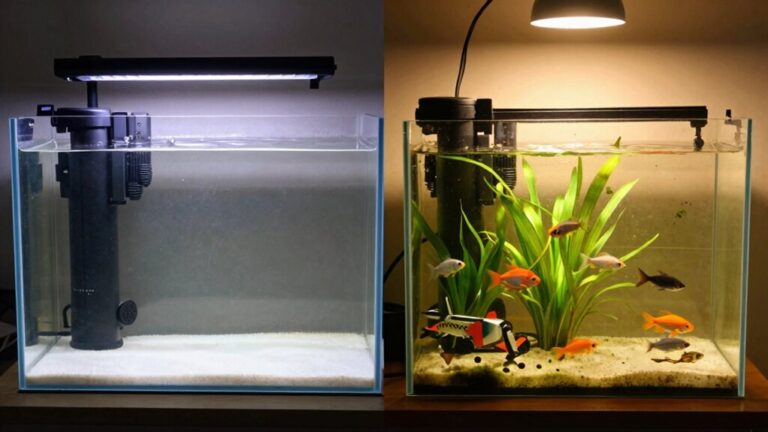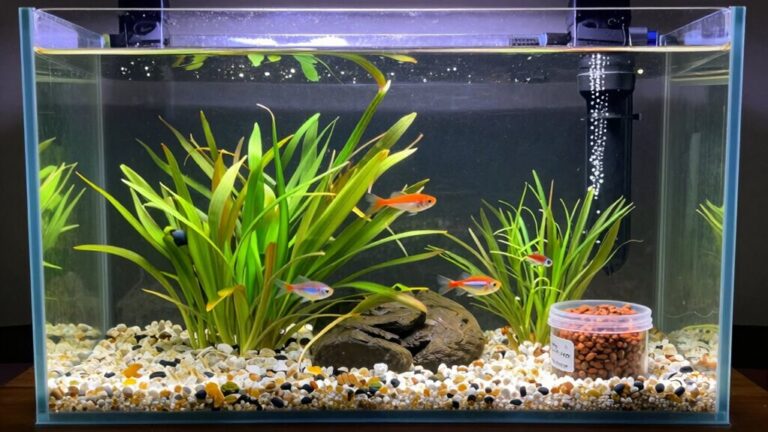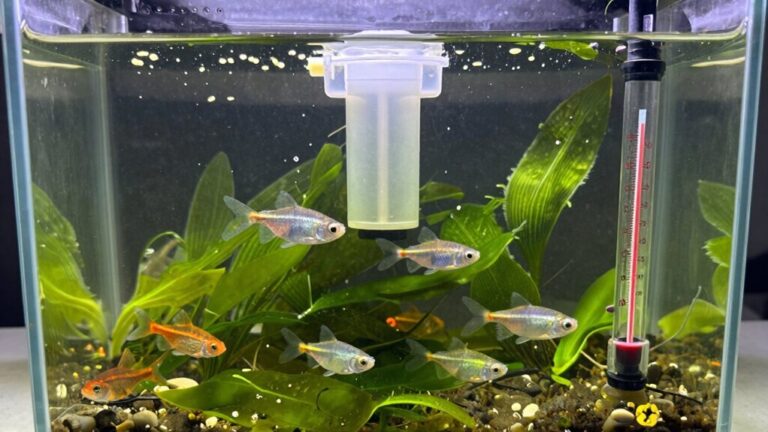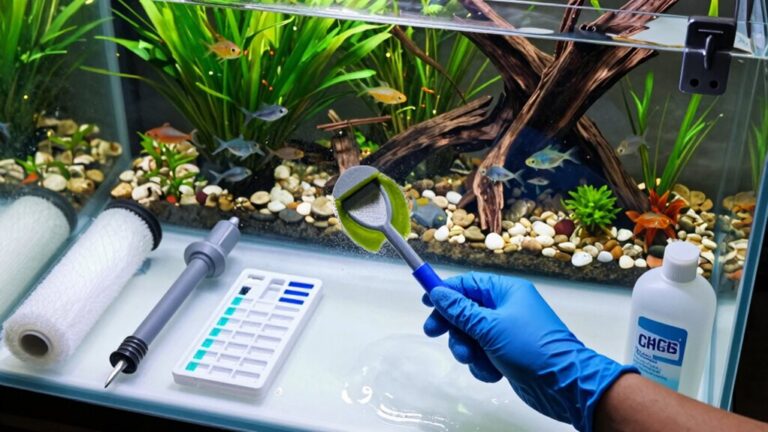

You’ll save substantial money with LEDs that use 80-90% less energy than traditional lights, despite higher upfront costs. Schedule your tank’s photoperiod to 8-10 hours daily and consider dimming to 70-80% for additional savings. For substrates, try affordable alternatives like cat litter (bentonite clay) or Akadama bonsai soil instead of premium options. Layer cheaper materials with quality substrate for maximum value, and maintain gently to extend lifespan. These smart choices pay off in both the short and long run.
LED Lighting: Smart Choices for Maximum Efficiency

When you’re setting up your aquarium, choosing the right lighting isn’t just about making your fish look pretty—it’s a crucial decision that impacts your tank’s health, your electricity bill, and your maintenance schedule.
LEDs are the clear winner in the aquarium lighting game, delivering 80-90% greater efficiency than old-school options. While the upfront cost might make you wince, you’ll smile when you calculate the savings. Modern LED systems provide impressive luminous efficacy that helps you compare different lighting options effectively. The AQUANEAT LED Full Spectrum Aquarium Light offers energy-efficient lighting solutions for compact tanks that still promote a vibrant aquatic environment.
A 50W LED fixture might cost $549 initially, but it’ll save you hundreds compared to a power-hungry 250W metal halide over its 50,000-hour lifespan. CTT’s product lines like BrightGrow and ReefGlow offer custom spectrum targeting that enhances both plant growth and fish coloration.
Plus, you won’t be climbing on chairs to replace bulbs every few months—LEDs last up to five times longer than fluorescents.
That’s fewer disruptions for your finned friends and more time enjoying your underwater world.
Budget-Friendly Lighting Operation Strategies
Operating your aquarium lights efficiently doesn’t have to drain your wallet.
You’ll save considerable money by scheduling your tank’s photoperiod to just 8-10 hours daily and using smart dimming controls that adjust brightness based on your specific needs. Implementing a consistent photoperiod schedule is essential for maintaining healthy plant growth.
These simple tweaks can slash your electricity consumption by up to 30%, while still keeping your aquatic plants thriving and your fish happy.
Consider selecting lights with appropriate Kelvin ratings based on your tank depth, as 10,000K lights are ideal for aquariums between 12-20 inches deep.
The market’s shift toward LED aquarium lighting has made energy efficiency more accessible, with LEDs dominating 43.2% of the market share due to their lower operating costs and customizable spectrums.
Strategic Photoperiod Scheduling
Although many aquarists focus on buying expensive lighting equipment, mastering your photoperiod schedule might be the smartest money-saving hack in your aquarium toolkit.
By optimizing when your lights run, you’ll cut electricity costs while keeping plants thriving and algae at bay. This approach helps maintain proper nutrients, which are essential for plant health.
For established tanks, aim for a single 8-10 hour lighting block rather than split periods, which can complicate CO₂ levels and plant health.
New setups should start with just 6-8 hours, gradually increasing by 30 minutes every few weeks. For lower light demanding tanks, you can extend photoperiods up to 12 hours safely while maintaining good coral health.
You’ll save even more by using short 15-30 minute ramp times for gentle shifts and staggering your light channels—run energy-hungry whites for shorter periods while keeping the efficient blues on longer.
Investing in reliable mechanical or smart timers can automate your lighting schedule and prevent costly mistakes like leaving lights on accidentally overnight.
Smart Dimming Controls
Despite what many aquarium companies want you to believe, you don’t need to spend hundreds on advanced lighting controllers to create a professionally-lit tank. Budget-friendly options abound, with inline DC dimmers under $30 offering manual control that remembers settings even after power outages. Smart home enthusiasts can integrate their aquarium lighting with Z-Wave or Zigbee devices for comprehensive automation solutions. Proper lighting is essential for plant health and overall fish well-being, so ensure that your setup meets the specific needs of your aquatic life.
You can save 20-30% on energy costs by simply dimming your lights to 70-80% brightness. This reduction also means less heat output and evaporation, saving you even more money long-term.
For automation without breaking the bank, consider using the Bluetooth controllers included with many modern LED fixtures, or explore DIY options using $20 microcontrollers running open-source firmware. The Twinstar controller provides a perfect balance with its turn-knob feature for precise adjustments while maintaining settings when used with timers.
Just be sure to verify voltage compatibility and keep non-waterproof components safely away from splash zones to avoid turning your budget hack into an expensive mistake!
Strategic Lighting Purchases for Long-Term Savings
When shopping for aquarium lighting, you’ll save thousands over time by focusing on PAR (Photosynthetically Active Radiation) values rather than just how pretty the lights look.
Your tank’s size should guide your spending—don’t waste money on powerful lights for a nano tank, or skimp on necessary wattage for larger setups. Consider that deeper tanks require more powerful lighting systems for effective light penetration to reach bottom-dwelling plants and corals. For optimal plant growth and ecosystem health, follow the 1-to-2 rule where your light’s wattage should be at least double your tank’s gallon size. Additionally, maintaining clean, balanced water is crucial for ensuring that the benefits of your lighting translate into healthy plant growth.
Remember that the $300 LED fixture that seems expensive today will actually cost half as much as cheaper alternatives when you factor in the bulb replacements and electricity costs over its 50,000-hour lifespan.
PAR Over Aesthetics
Many hobbyists make the costly mistake of choosing aquarium lights based on how they make their tank look rather than what their plants actually need.
PAR (Photosynthetically Active Radiation) is what drives plant growth, not the brightness your eyes perceive or that perfect “sunset glow” you’re chasing.
Prioritize PAR over aesthetics to save money and frustration:
- Your lush, thriving plants will create a more beautiful tank than any high-lumen, low-PAR light ever could.
- You’ll slash your replacement costs when plants actually survive instead of slowly dying.
- Your wallet will thank you when energy-efficient, PAR-focused LEDs cut your electric bill.
- You’ll spend less fighting algae blooms that plague improperly lit tanks.
- Additionally, investing in sustainable plants will enhance the overall health of your aquarium ecosystem.
Scale Before Spending
Why rush into buying expensive aquarium lighting when strategic planning can save you hundreds of dollars?
Before splurging on that $800 Kessil light, consider your tank’s actual needs. DIY solutions using adhesive-backed LED strips can illuminate your aquarium for under $50, while still providing the 6,000-6,500 Kelvin spectrum your plants crave.
You’ll recoup your investment faster with LED lighting, which uses 40-90% less energy than fluorescent options. Additionally, the energy efficiency of LED systems translates to significant cost savings over time.
Pair this with smart timer scheduling that mimics sunrise and sunset patterns instead of blasting at full power all day.
Position your tank in temperature-stable locations to minimize additional energy needs. For multiple tanks, these efficiency measures become even more valuable.
Affordable Substrate Alternatives That Work
Five budget-friendly substrate options can transform your aquarium without draining your wallet. You don’t need to spend a fortune on premium aquasoils when these alternatives deliver surprising results for plant growth and water chemistry.
- Cat litter (especially dark brown bentonite) outperforms plain sand and offers excellent nutrient exchange capability.
- Akadama bonsai soil provides volcanic goodness that rivals expensive planted tank substrates.
- Tropica AquaCare gives you professional results at a fraction of the cost (one 5L bag covers smaller tanks!).
- Layered approaches let you use cheaper materials as base layers while maintaining plant benefits. Creating a layered setup with inexpensive large-pore gravel beneath a thin cap of quality substrate stretches your dollars further. Your plants won’t know the difference, but your wallet certainly will! Additionally, using nutrient-rich substrates ensures that aquatic plants thrive and establish strong root systems.
DIY Substrate Solutions for Plant Growth
Creating your own substrate mix from everyday materials offers an exciting pathway to lush aquatic plant growth without spending a fortune on commercial products.
You’ll be amazed at how simple kitchen and garden items can transform your tank’s ecosystem!
Try a dirt-capped setup with garden soil as a nutrient-rich base layer topped with sand or fine gravel. For ideal results, aim for at least 1.5 inches of depth to support healthy root development.
Or create a layered system using peat at the bottom for nutrients, a middle layer of medium gravel, and fine gravel on top.
Don’t forget to improve your mix with powdered clay for iron content and better nutrient exchange. Additionally, the right substrate can significantly influence water chemistry, affecting the overall health of your aquarium.
You can even condition clay with carbonated water before use – your plants will thank you!
Extending Substrate Lifespan Through Proper Maintenance

While many aquarists focus on adding colorful fish or striking decorations to their tanks, proper substrate maintenance remains the unsung hero of long-lasting aquarium health.
You’ll save money and effort by understanding the right care techniques for your aquarium’s foundation.
When maintaining your substrate, remember these key practices:
- Light vacuuming during water changes preserves beneficial bacteria while removing visible waste
- Planted tanks need gentler maintenance—avoid disturbing roots and nutrient layers
- Strategic barrier placement prevents substrate mixing, maintaining those beautiful contours
- Regular but gentle agitation of sand surfaces prevents harmful anaerobic pockets
You don’t need to replace substrate often if you’re diligent with weekly water changes of 10-25%. Additionally, maintaining your filter is vital during water changes as it contributes significantly to overall tank health.
For planted tanks, consider replenishing nutrient tablets every 4-6 weeks rather than disturbing the entire bed—your plants and wallet will thank you!
Energy-Saving Light Positioning and Enhancement Techniques
Smart light positioning in your aquarium can dramatically reduce energy costs while creating the perfect environment for your aquatic friends.
Mount your LEDs with wide-angle lenses (90°-120°) to guarantee even distribution throughout the tank, and avoid placing them too close to the water surface.
You’ll save considerable energy by switching to LEDs, which use 90% less power than fluorescents and direct all light toward your tank.
Set timers for 8-10 hours daily instead of the typical 12, and consider dimming during “sunrise” and “sunset” periods.
Don’t overlook the power of ambient light!
Positioning your tank near a window (but avoiding direct sunlight) provides natural illumination that supports healthy day-night cycles for your fish while reducing your reliance on artificial lighting.
Tracking Costs: The Key to Informed Aquarium Investments
Beyond optimizing your lighting setup, effective cost management forms the backbone of any successful aquarium hobby.
Using apps like Aquarimate or AquaTrack helps you monitor where every dollar goes, revealing surprising patterns in your spending habits.
- That moment when you realize you’ve spent more on fancy rocks than on your anniversary dinner ????
- The satisfaction of watching your utility bill drop after switching to LED lighting
- The pride in showing friends your thriving tank that cost less than theirs
- The relief of having maintenance records when troubleshooting mysterious algae blooms
Categorize your expenses into fixed costs (equipment) and variables (fish, food, electricity), then analyze this data regularly.
Your future self will thank you when making decisions about upgrades or expansions—especially when justifying that new coral purchase to your noteworthy other!
Frequently Asked Questions
Can Sunlight Replace Artificial Lighting for Planted Tanks?
No, you shouldn’t rely solely on sunlight. It’s too inconsistent, difficult to control, and often causes algae problems. You’ll need artificial lighting to maintain stable conditions for your aquarium plants.
How Do Colored LED Lights Affect Plant Growth Versus White?
Colored LEDs (red/blue) directly fuel photosynthesis while white light often lacks these wavelengths. You’ll get denser growth with red/blue, but you’ll need to add green to prevent a purple-tinted, washed-out appearance in your tank.
Will Mixing Substrate Brands Cause Chemical Compatibility Problems?
You can safely mix different substrate brands. They won’t cause chemical compatibility issues, though you’ll want to match grain sizes to prevent compaction and separate active from inert substrates to maintain their intended functions.
Can You Safely Use Outdoor Garden Soil in Aquariums?
No, you shouldn’t use outdoor garden soil in aquariums. It causes water quality issues, pH instability, algae blooms, and plant die-off. Garden soil lacks proper bacteria and oxygen when submerged, despite its nutrient content.
Do Smart Home Systems Work With Aquarium Lighting Control?
Yes, you’ll find several smart home systems work great with aquarium lighting. You can use Sylvania, ColorPlus, or Serene products with SmartThings, Alexa, or Google Assistant for scheduling, dimming, and color control.
Final Thoughts
You’ve now got a treasure trove of money-saving strategies for your aquarium. By making smart lighting choices, exploring DIY substrate options, and tracking your expenses, you’ll create a thriving underwater world without draining your wallet. Remember, the most successful aquarists balance creativity with practicality. Your fish will be happy, your plants will flourish, and your budget will thank you for these thoughtful investments in your aquatic hobby.